What Actually Fits: Everyday Items Measured Against Your Boot
"Will it fit?" is easy to answer when you know two numbers: the size of the thing, and the size of your boot. The problem is that most people know neither — they eyeball both, and one of them lies. Here are realistic dimensions for the everyday stuff people actually move, matched against typical boot sizes by car class.
Boot Sizes by Car Class (Seats Up)
Manufacturer boot figures are in litres — useless for an "will X fit" question. What matters is the rectangular usable floor and the height under the parcel shelf. Rough but honest figures for common classes:
Note that "seats folded" changes everything — a RAV4 jumps from about 100cm (39in) to about 180cm (71in) of load depth. If you're regularly hauling, that fold is the most valuable 5 seconds of your trip.
The Everyday Item Dimension Sheet
Realistic bounding-box sizes for the things people actually want to move. Treat them as honest approximations — always measure your own item, especially for anything in a box, since package sizes vary between brands and models.
Match-Ups: What Fits Where
Now put the two lists together. The match-ups that come up constantly:
- Folded stroller: fits every car class listed above, any configuration. This one is never the problem.
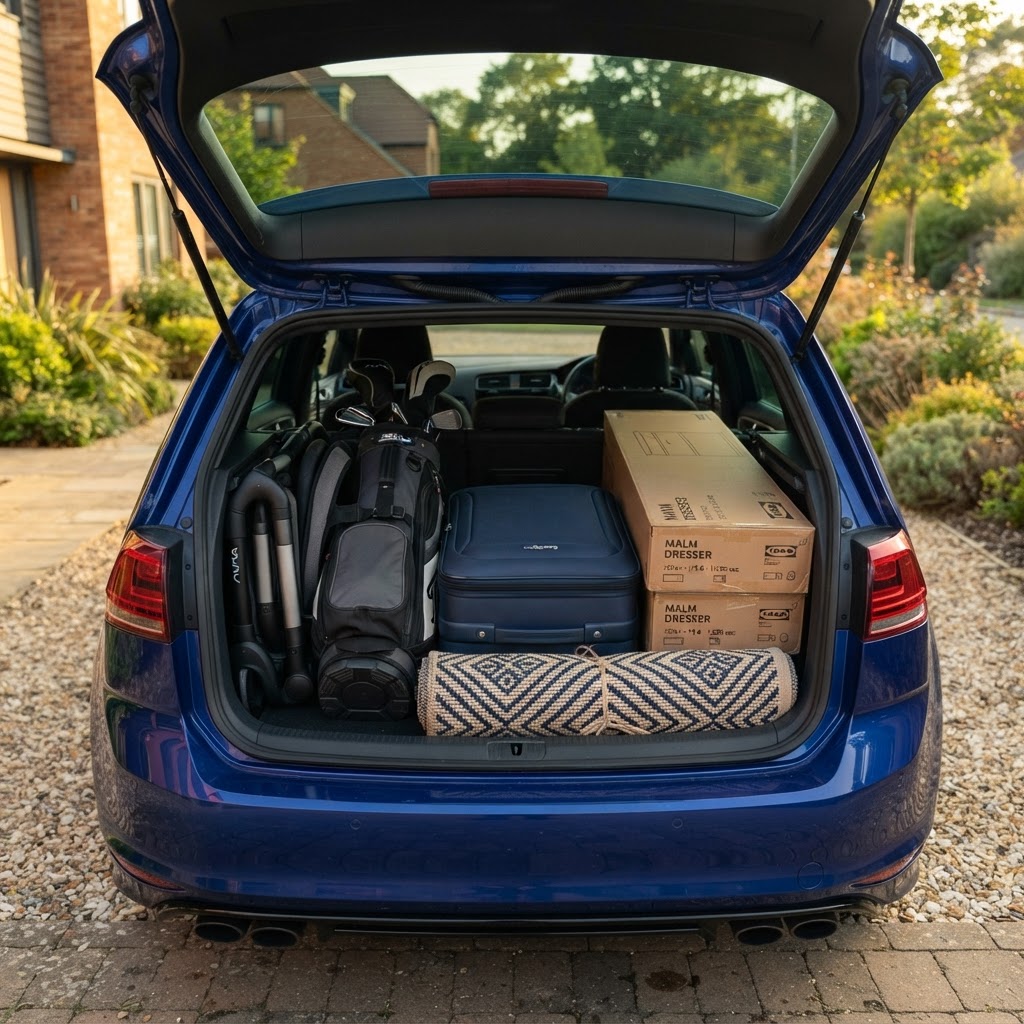
- Golf bag: stands up in most medium and large SUVs; in a hatch it lies diagonally across the boot with the seats-folded depth. It's the 110cm (43in) height that catches people out — most parcel shelves sit at 75–80cm (30–31in).
- Medium & large suitcases: two mediums fit a mid hatch seats-up with room to spare; a large case fits a small hatch only if it goes in at an angle or the parcel shelf comes out.
- 65" TV box: the boss of everyday items. Roughly 160cm (63in) long means seats folded in almost any hatch, SUV or wagon, laid flat screen-up. Never on its edge, never squeezed between hard objects, and never on the roof.
- Washing machine box: 85 × 70 × 70cm (33 × 28 × 28in) fits most medium SUVs seats-up, but the 60–70kg (132–165lb) weight means it belongs on the boot floor, against the seat back, strapped — not lifted over a rear seat.
- Flat-pack chair boxes: the easy haul — two or three stack flat in any hatch. Four-shelf bookcase boxes (150cm / 59in) need seats folded in anything but a wagon.
- 40L esky: fits any boot seats-up, but a full esky weighs 25–40kg (55–88lb) — keep it low and forward of the axle.
- Bike: front wheel off, in diagonally, is a wagon and large SUV game. In smaller cars, look at a roof or towbar carrier before you force it.
- 6ft Christmas tree box: at 180cm (71in), nothing with a tailgate fits it inside. This one is a roof-rack item or a delivery — or buy the 4ft version.
The Diagonal Myth and the Taper Trap
People look at a boot's maximum diagonal and assume items that long will fit. Two problems: boot openings taper — the opening is narrower than the floor, and the ceiling slopes toward the tailgate — and rear wheel wells pinch the floor at exactly the height where most loads want to sit. The usable rectangle is always smaller than the longest diagonal.
Measure the opening, not just the floor: the narrowest point of the boot mouth sets what you can physically feed in, no matter how big the space behind it is. That's why stowey's diagram asks about wheel wells — they quietly steal 20–30% of floor width at the rear for many cars.
How to Measure Without the Guesswork
- Measure items as they'll travel — collapsed, boxed, or with parts removed (a bike with its front wheel off is a different item).
- Use the bounding box: the smallest box the item would fit inside. Don't measure handlebars and separately promise they'll be "fine".
- Measure your boot at its narrowest and lowest usable points, with the parcel shelf in place if you're keeping it there.
- Then stop doing maths in the car park — enter both sets of numbers into a packing calculator and let it place every item for you, including what needs to go in first and what should ride on top.
Run Your Own Match-Up
Enter your car and any custom item dimensions in stowey — you'll get an animated 3D packing plan showing exactly what fits and what doesn't.
Check your items