
How to Transport Bunnings Supplies: Your Car vs What You're Buying
The classic Bunnings dilemma: you're standing at the checkout with a trolley load of supplies, wondering if it'll actually fit in your car. This guide breaks down the most common Bunnings products by transport challenge — so you can plan before you go.
12 min read
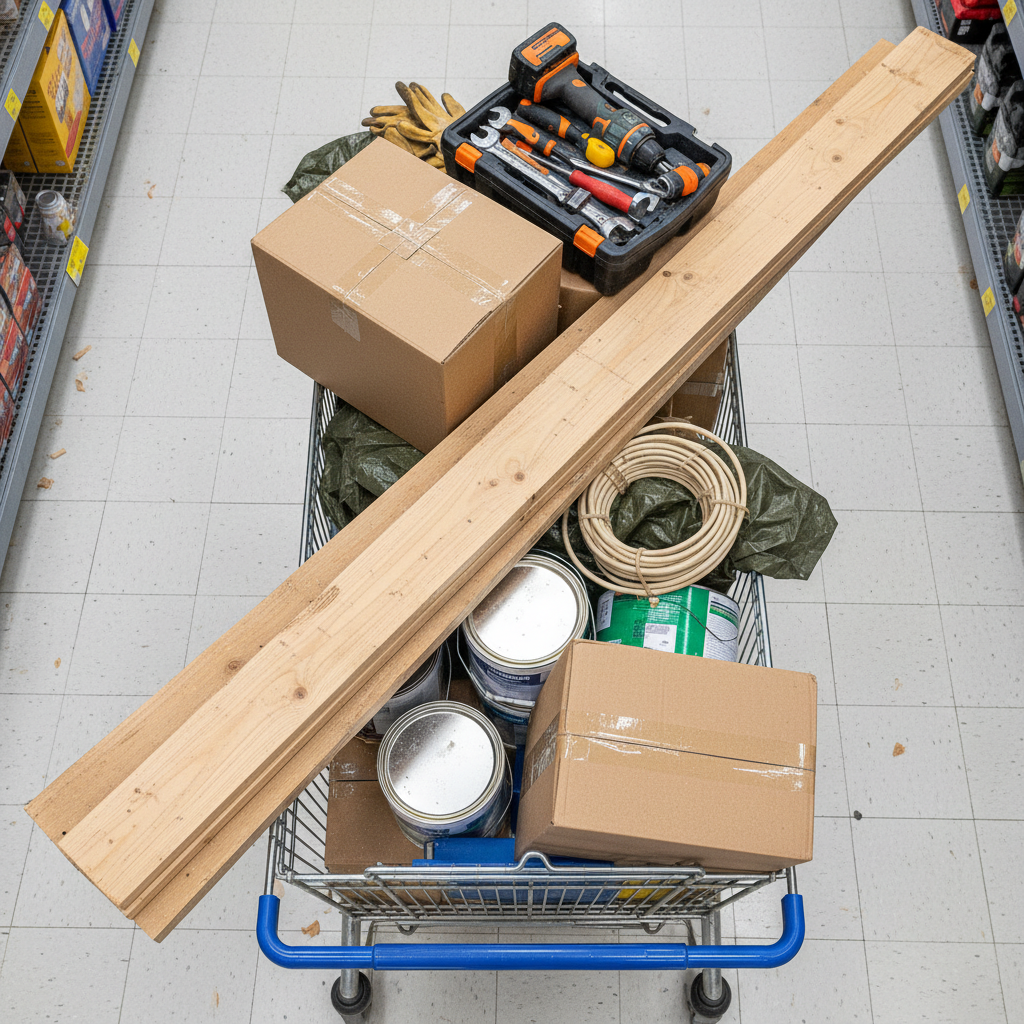
The Two Problems: Size and Weight
Transporting Bunnings supplies creates two distinct challenges that most shoppers only think about when they're in the car park with a trolley: size (will the box physically fit?) and weight (can your car legally and safely carry this?).
Most passenger cars have a payload rating of 400–600kg (880–1,300lb, including all passengers and cargo). A 70kg (154lb) driver with two passengers already uses 210kg (463lb) of that budget. Add 10 bags of concrete at 20kg (44lb) each (200kg / 441lb) and you're close to the limit — before you've loaded the tools, the timber, and the garden supplies.
Exceeding your vehicle's Gross Vehicle Mass (GVM) voids your insurance, accelerates tyre and suspension wear, and significantly increases stopping distance. Always check your door placard for the payload rating.
Product-by-Product Guide
Here's how the most common Bunnings purchases break down by transport challenge:
🪵 Timber & Sheet Goods
The challenge
Length — sheets are typically 2400 × 1200mm (94 × 47in) and won't fit in most cars without an overhang or a roof rack.
The solution
For sheets: a ute tray or van is ideal. For boards under 2.4m (7ft 10in), fold rear seats flat and load diagonally in a wagon or large SUV. Always tie down any overhang with a red flag if exceeding 150mm (6in) past the rear bumper (Australian road law).
🏗️ Bags of Concrete, Sand & Soil
The challenge
Weight — a standard 20kg (44lb) bag of concrete is manageable; 10 of them (200kg / 441lb) is not. Most passenger cars have a payload of 400–500kg (880–1,100lb) including passengers.
The solution
Limit concrete runs to 8–10 bags at a time in a typical sedan or hatchback. Always check your car's payload rating (door placard or owner's manual). Spread weight across the boot floor and don't stack more than 3 bags high.
🏠 Garden Sheds & Gazebos (Flat Pack)
The challenge
Volume — large shed kits can come in multiple large boxes totalling 4–6 cubic metres of space.
The solution
These require a van, trailer, or Bunnings' home delivery service. Even large SUVs struggle with full shed kits. Check box dimensions before you visit the store.
🧱 Paving Stones & Retaining Wall Blocks
The challenge
Both weight and volume. A full pallet of pavers exceeds any car's payload. Even a partial load adds up fast — 50 pavers at 4kg (9lb) each is 200kg (441lb).
The solution
Make multiple trips with 30–40 blocks maximum. Better yet, use Bunnings' delivery service for large landscaping orders. Spread blocks flat across the boot floor, never stacked.
🏗️ Corrugated Roofing Iron
The challenge
Length (typically 3–6 metres / 10–20ft) and the sharp edges are a hazard.
The solution
Roofing iron must be transported on a ute tray or trailer. Never attempt to carry corrugated iron inside a car cabin — the edges can cause serious injury in a sudden stop.
🗄️ Garden Sheds & Storage Cabinets
The challenge
Box dimensions often deceive — a flat-pack cabinet might be 200 × 60 × 20cm (79 × 24 × 8in) when boxed.
The solution
For single cabinets, a large SUV or wagon with seats down usually works. Check the longest dimension against your car's load floor length (seats folded). Load widest panel first, flat on the floor.
🪵 Decking Boards
The challenge
Standard deck boards are typically 5.4m (17ft 9in) long — no consumer vehicle can transport these without professional delivery.
The solution
For shorter boards (1.8–2.4m / 6–8ft), fold rear seats and use a wagon. Longer boards need a ute tray or Bunnings delivery. Ask Bunnings to cut boards on-site if your project allows it.
🏗️ Fencing Panels (Timber & Colorbond)
The challenge
Colorbond panels are 1.8m (5ft 11in) wide and can be up to 2.4m (7ft 10in) long. Timber paling fences are bundled awkwardly.
The solution
Colorbond panels must lay flat — they can warp or crease if stored upright. Requires a flat ute tray or trailer. Paling fence bundles (shorter lengths) can sometimes squeeze into a wagon boot with seats down.
Bunnings Delivery: When to Use It
Bunnings offers home delivery and in-store Click & Deliver for most large items. It's worth comparing the delivery cost against your alternatives:
- Hired ute or van: Typically $60–$100 for a few hours plus fuel. Makes sense for multiple large items in one trip.
- Bunnings delivery: Often $35–$80 for standard items, with heavier items (concrete, pavers) priced separately. Best for single large orders.
- Borrowing a ute or trailer: Many councils have trailer hire programs for cheap hourly rates. Check your local council's website.
For landscaping projects involving multiple cubic metres of materials (soil, gravel, pavers), getting a quoted truck delivery is almost always more economical than multiple car trips — and far safer.
Australian Road Laws for Oversize Loads
If you do carry long items that overhang your vehicle, Australia has specific requirements (for informational purposes — always check your state's road rules):
- Up to 150mm (6in) overhang: No special requirements in most states.
- 150mm (6in) to 1 metre (3ft 3in): A red or orange flag is required at the rear of the load.
- Over 1 metre (3ft 3in): Generally requires a rear marker board and may require police notification or an escort in some states.
- Over 3 metres (10ft): Typically requires a permit and pilot vehicles. This applies to situations like carrying long roofing sheets on a trailer.
Note: This is general information only. Road rules vary by state and territory. Always check your local road authority for current regulations.
Check Before You Buy
Use stowey's Bunnings calculator to search for the exact products you're planning to buy and check whether they fit in your specific car — before you make the trip.
Try the Bunnings Calculator