
Boot Accessories That Make Packing Easier
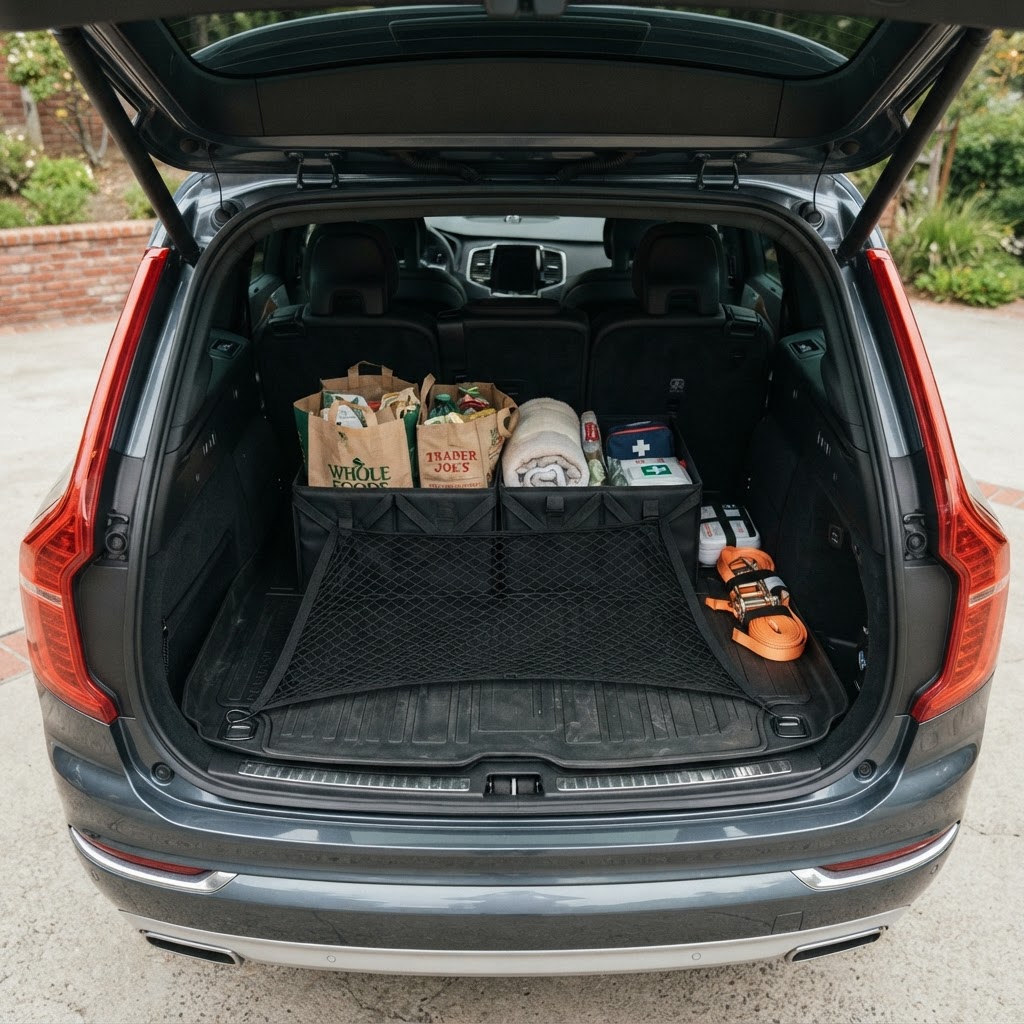
A boot liner keeps the carpet clean. An organiser stops the shopping from rolling around. A cargo net keeps the esky from becoming a projectile. But every accessory you add also takes up space — and most people never account for it. Here's what each one actually does for you, what it costs you, and when it's worth fitting.
Why Accessories Change the Maths
Your car's published boot dimensions are bare measurements — an empty, carpeted box. The moment you line the floor, divide the space with organisers, or clip in a net, the usable volume changes. A thick rubber liner can lift the floor by 1–2cm (0.4–0.8in). A three-compartment organiser can carve your boot width into sections too narrow for a suitcase.
That's why a packing calculator like stowey works from the bare boot dimensions. If you drive with permanent accessories fitted, the safe approach is to measure your actual usable space with them in place — or simply knock a couple of centimetres off your mental height figure for a liner.
Boot Liners & Mats: Protection First
The single best-value accessory for anyone who hauls anything. A fitted rubber or moulded liner catches dirt, sand, paint tins, and chain grease, and a raised lip contains spills. Cheaper fabric mats protect the carpet but don't stop liquids.
- Space cost: roughly 1–2cm (0.4–0.8in) of height with a moulded liner, plus a lip of 2–4cm (0.8–1.6in) around the edges that can block the last few centimetres of floor width.
- Worth it when: you carry garden gear, sports equipment, pets, or hardware regularly.
- Skip it when: you're doing one careful furniture run — a blanket or flattened cardboard does the same job for free.
- Buy the fitted version for your exact model. Universal liners rarely match the wheel well shapes and waste more floor than they should.
Boot Organisers & Cargo Dividers
Collapsible fabric organisers, box dividers, and hanging organisers are the antidote to "everything rolls to one side". They shine for shopping, sports gear, and tools — items that are individually small and annoying.
- Space cost: the biggest of any accessory. A three-section organiser effectively thirds your boot width. One tall divider can make a boot too narrow for a flat-pack wardrobe box.
- The golden rule: organisers are for small-item life, not for hauls. Unzip, fold flat, or remove them entirely before a big IKEA or Bunnings run — a folded organiser costs you nothing.
- Choose vertical over horizontal where you can: a hanging organiser on the back of the rear seats uses space you can't otherwise fill, instead of carving up the floor.
Cargo Nets & Privacy Covers
A stretch cargo net clipped across the boot is cheap, weighs nothing, and stops the weekly shopping from migrating into the wheel wells. They're brilliant for bags and soft items — but be honest about their limits.
A net is not a restraint. In a heavy braking event, a 15kg (33lb) box will go straight through an elastic net. Heavy and hard items need to sit low, against the seat back, strapped to a proper anchor point. Use the net for what it's good at: light, soft, shift-prone items.
The retractable privacy cover that came with your car is also a usable shelf — but only for genuinely light items (jackets, picnic rugs). It's not designed to carry weight, and it's the first thing to remove when you need boot height. Every tall load starts with popping the parcel shelf out.
Straps, Tie-Downs & Anchor Points
Most modern cars have four anchor points in the boot — use them. A pair of cam straps (the kind with a buckle you tighten by pulling) turns an awkward load into a safe one for under $20.
- Cam straps over bungee cords: bungees stretch, which means they absorb energy and then launch it. A cam strap only gets tighter.
- Loop through the load, not around the whole boot: strap heavy items to the anchor points nearest them, as low as possible.
- Keep a set in the car permanently. They weigh nothing and they're the difference between "that moved a bit" and "that's in the back seat".
The Space Cost Cheat Sheet
A quick reference for what each accessory costs you in usable boot space — and when it earns it back:
When Accessories Hurt More Than Help
The common trap: fitting everything, then wondering why the wardrobe box "should fit but doesn't". If you're planning a big load, strip the boot back to bare first — liner out (or measure with it in), organisers removed, parcel shelf out, nets unclipped and pushed aside. You'll be surprised how much space your daily setup was quietly absorbing.
Then plan the load in a packing calculator against those bare dimensions, with a centimetre or two of margin for real-world tolerances. Plan first, fit accessories after the heavy stuff is in.
See What Fits Before You Fit Anything
Use stowey to check your items against your boot's dimensions — seats up or folded — and get a step-by-step loading plan.
Try the packing calculator